
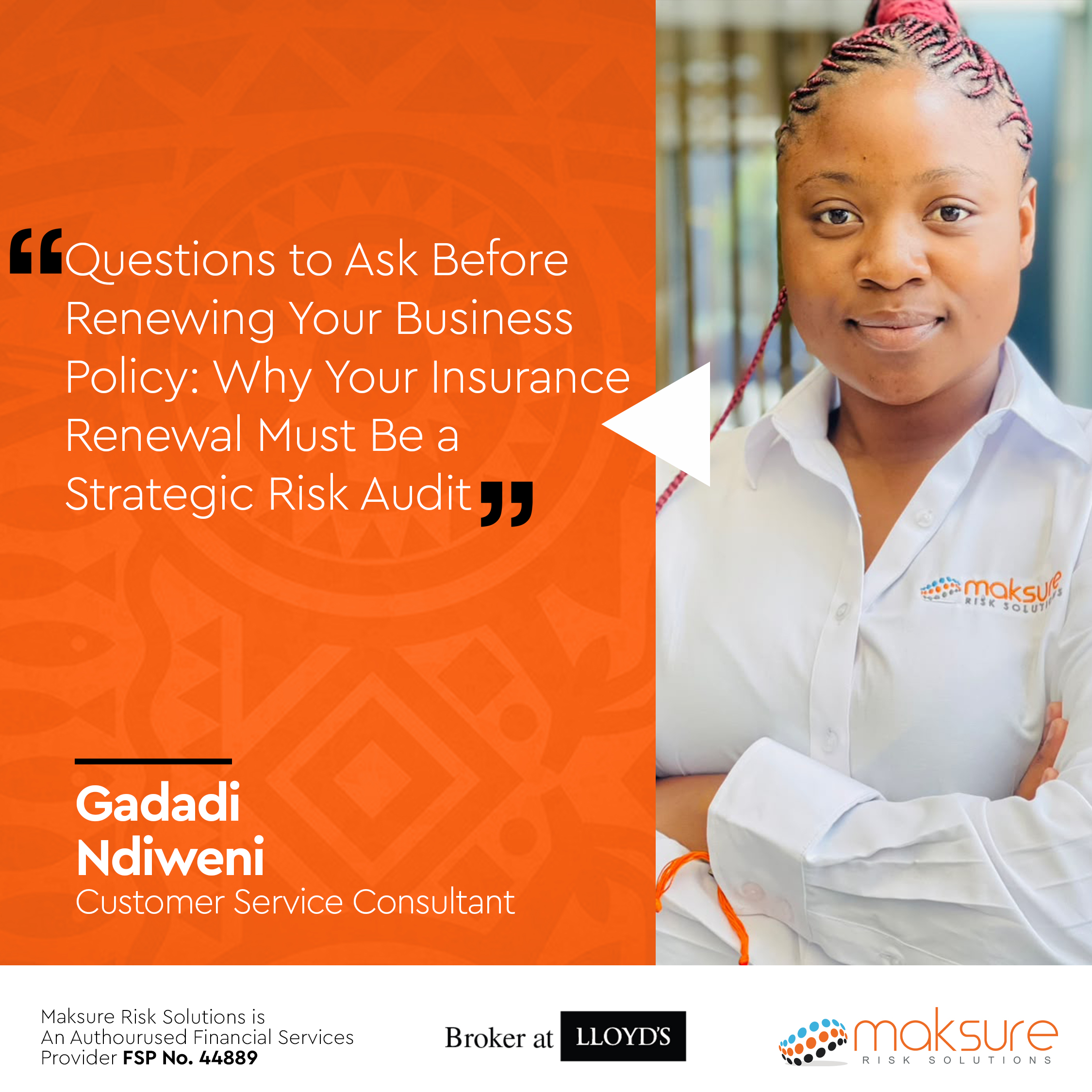
Questions to Ask Before Renewing Your Business Policy: Why Your Insurance Renewal Must Be a Strategic Risk Audit.
For most corporate decision-makers, insurance renewal follows a comfortable, mechanical routine: updated asset spreadsheets are submitted, rates are adjusted, premiums are negotiated, and policies are signed for another twelve months.
Treating renewal as a routine administrative exercise is one of the most significant balance-sheet vulnerabilities a company can accept. Over a single financial year, operations inevitably shift. Revenue trajectories expand, digital footprints widen, supply chains reorganise, inflation alters replacement costs, and contractual liabilities accumulate. Yet, corporate insurance programs frequently remain static. When an organization evolves faster than its risk cover, catastrophic protection gaps open.
At Maksure, we challenge executive teams to pivot their annual renewal strategy away from basic price procurement and toward a rigorous strategic risk audit. We believe every business should use its annual renewal to answer one fundamental question: If we suffered a major loss tomorrow, would the insurance program we are renewing today actually protect the business we operate now?
Before authorising your next policy placement, your board and risk management team must evaluate these 16 critical questions organised under five structural risk pillars.
Pillar 1: Operational Reality & Asset Valuation
1. Has Our Business Changed During the Last 12 Months?
Start with operational realities rather than policy schedules. Have you opened new locations, acquired specialised machinery, expanded warehouses, launched products, or entered new international markets? When a business evolves but its cover remains unchanged, structural gaps immediately open.
2. Are Our Asset Values Still Accurate?
Insurance value is about replacement cost - not accounting book value or market value. Rapid inflation, currency fluctuations on imported machinery, construction costs, and supply-chain constraints mean replacing specialised assets costs significantly more today than it did years ago, creating severe underinsurance risk.
3. Is Our Business Interruption Limit Enough?
Physical property repairs are only half the battle. If a major event halts operations for months, salaries, debt obligations, and overhead costs continue while revenue collapses. Realistically calculate how long operational recovery will take -12 months is rarely enough for complex industrial operations with long equipment lead times.
Pillar 2: Ecosystem Dependencies & Supply-Chain Vulnerabilities
4. What Could Stop Our Business Even If Our Own Property Is Undamaged?
Your facilities do not need to burn down for your revenue to stop. Power outages, port delays, cloud provider downtime, or catastrophic losses at a major customer or supplier can halt operations. Supply-chain and contingent business interruption exposures must be audited.
5. Who Are Our Critical Suppliers?
Your largest supplier is not always your most critical one. A small, highly specialised vendor supplying a single custom component can halt your entire production line if they experience a loss. Identify these sole-source dependencies and map their impact on your operational risk profile.
6. Have Our Maximum Loss Scenarios Changed?
Coverage limits should reflect realistic worst-case events, not just total asset totals. Assess credible scenarios with your risk advisers: a fire spreading across adjacent facilities, concentrated stock accumulation, severe regional flooding, or an organisation-wide cyber event.
Pillar 3: Limit Rationalisation & Contractual Alignment
7. Are We Buying the Right Limits -or Simply Repeating Last Year’s?
Renewing R100 million in liability or R50 million in cyber cover simply because "that is what we bought last year" is an assumption, not a strategy. Every limit requires a clear rationale based on current contractual liabilities, market conditions, and operational scale.
8. What Are We Self-Insuring Without Realising It?
Every organisation retains risk through deductibles. However, hidden self-insurance occurs through policy exclusions, low sub-limits, or unmapped coverage gaps. There is a critical difference between intentionally retaining a risk and being caught accidentally uninsured.
9. Have Our Contracts Created New Insurance Obligations?
Commercial agreements - lease covenants, customer master service agreements, lender terms, and joint-venture contracts - frequently alter your legal obligations. Ensure active contracts are reconciled directly with your insurance program to prevent uninsured breach-of-contract claims.
Pillar 4: Claims Intelligence & Emerging Exposures
10. Has Our Cyber Risk Changed?
Cyber exposures evolve faster than any annual policy cycle. Adding tools, connecting new vendors, or integrating artificial intelligence alters your attack surface. Cyber insurance must sit behind a comprehensive risk management framework, incident response plan, and continuous backup protocol.
11. Do We Understand Our Claims?
Claims data offers profound diagnostic value. Analysing loss patterns - recurring machinery failures, localised theft, or driver risk - allows you to convert claims data into operational risk improvements that drive down future loss frequency.
12. Have We Implemented Previous Risk Recommendations?
Demonstrating that you have acted on engineer surveys - such as upgrading sprinkler systems, electrical maintenance, or security controls - proves risk quality to underwriters, giving your broker strong leverage to negotiate superior terms.
Pillar 5: Market Capitalisation & Alternative Risk Transfer
13. Are We Using the Right Insurance Markets?
As your organisation grows, its risk complexity changes. The insurer that suited your business five years ago may lack the capacity, international reach, or claims-handling expertise required for your corporate profile today.
14. Are We Taking Advantage of Current Insurance Market Conditions?
When market conditions favor buyers, leverage should not only be used to reduce premiums. Use favorable conditions to broaden policy wording, drop restrictive exclusions, raise sub-limits, or reduce deductibles for the same overall spend.
15. Should We Retain More Risk?
Larger corporate entities must evaluate risk financing strategically. Increasing deductibles or utilising alternative risk transfer structures - such as cell captives, allows you to fund predictable losses efficiently while buying commercial insurance for catastrophic events.
16. What Would Happen If We Had Our Worst Loss Tomorrow?
Imagine your most feared operational catastrophe occurs tomorrow morning. Would your program respond as expected? Are values accurate, limits sufficient, and claims-response protocols clear? If there is any uncertainty, your renewal process is not finished.
Elevate Your Renewal Strategy
An annual insurance renewal should never be defined by a minor percentage shift in premium. It is a board-level imperative to protect your balance sheet, your cash flow, and your long-term enterprise value.
The best renewal processes bring together executive leadership, finance, operations, and risk management to ask three fundamental questions: What has changed in our business? What could seriously hurt us? How should we insure it?
If your organisation suffered its largest-ever operational loss tomorrow morning, would you still be comfortable with the insurance program you are buying today?
Partner with Maksure to convert your annual renewal into a strategic risk review. Contact our executive advisory team today to schedule your comprehensive policy review before your next renewal.
Gadadi Ndiweni: Customer Service Consultant, Maksure Risk Solutions. She specialises in client support, policy administration, and service delivery at Maksure Risk Solutions. Dedicated to seamless client experience, Gadadi assists businesses in reviewing policy structures, navigating renewals, and ensuring their insurance coverage remains responsive to their evolving operational needs.
Visit: www.maksure.co.za | Contact: info@maksure.co.za
Maksure Risk Solutions is an Afro-Global independent specialist insurance and reinsurance broker with business footprint in Africa, Asia, East & Western Europe, South America and the Caribbean. We provide innovative and tailor-made risk solutions in Insurance and Reinsurance as well as Risk Financing and Actuarial Consulting geared towards capital management and strengthening our client’s balance sheet. Maksure is also one of the major players in Captive Management (Establishment & Management) in South Africa, Mauritius, Bermuda and various other jurisdictions. We have access into the Lloyds of London with a deep understanding of African markets. Our global nature ensures that our clients access quality capacity as well as some of the world’s latest thinking and solutions.
Recent Posts


5 tendencias que marcarán el mercado de reaseguros en México en 2027

Beyond the Horizon: Why Port Risk Management Demands an End-to-End Supply Chain Perspective

Lo que los mercados de seguros de Sudáfrica y Méxicopueden aprender el uno del otro

One Workforce, Many Countries: Navigating Pan-African Healthcare with Strategic Precision.



Linking African Risks to Global Markets from a London Perspective

The Rock Is Not the Risk: Rethinking Strategy and Resilience in the Critical Minerals Race

