
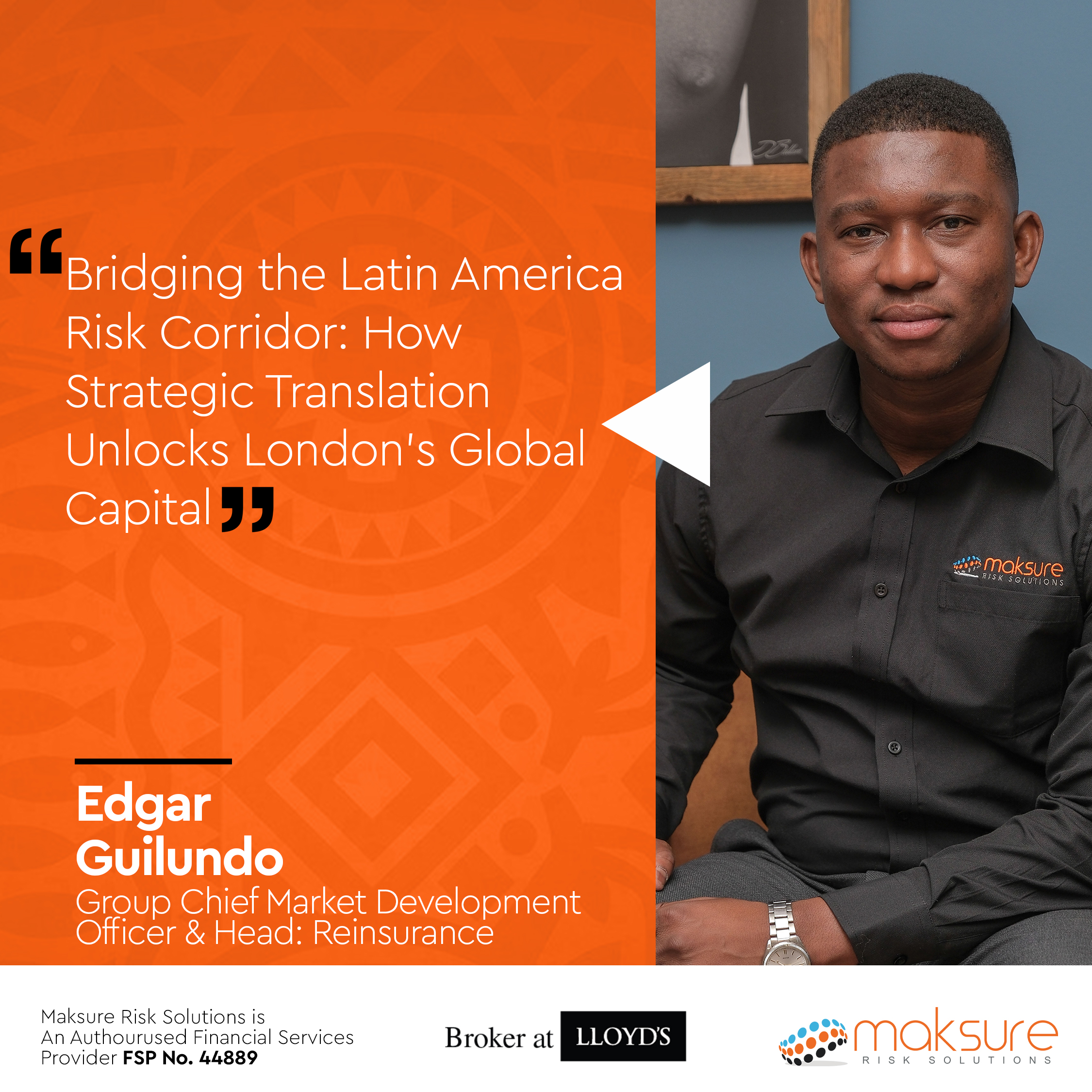
Bridging the Latin America Risk Corridor: How Strategic Translation Unlocks London’s Global Capital
From the trading floors of London to the industrial heartlands of Latin America, a fundamental shift is underway in how complex commercial and specialty risks access global balance sheets. Latin America presents one of the most compelling growth stories in global reinsurance, combining rapid economic expansion with vast natural resources, complex infrastructure, and severe natural catastrophe exposures. Yet, for too long, the channel connecting Latin American risk to London capital has relied on traditional, transactional placement models that fail to capture the true operational reality of regional assets.
To unlock sustainable capacity and protect high-value assets across Mexico, Brazil, Chile, and the wider region, the market must evolve. Bridging Latin America’s complex risk landscape to international markets requires moving beyond basic risk placement toward rigorous, analytical risk translation.
The Capacity Fallacy: Why Information Quality Dictates Capital Deployment
There is no shortage of global insurance capital. The London Market represents an estimated US$187 billion in gross written premium and commands roughly 8.7% of the global insurance and reinsurance market. It remains the ultimate ecosystem for complex risk, bringing together syndicates, brokers, actuaries, and underwriters under one roof.
However, major industrial projects - from Mexican manufacturing plants and Brazilian energy installations to Chilean copper mines and regional infrastructure programs - frequently face capacity bottlenecks. The core issue is not a global scarcity of capital, but a failure of clarity.
For an underwriter sitting in London, thousands of kilometres away from the physical asset, deploying balance sheet capacity depends entirely on the granularity and transparency of the risk presentation. To price and structure coverage effectively, underwriters require precise answers:
- Scenario Modelling: What are the realistic Probable Maximum Loss (PML) scenarios across severe earthquake, hurricane, and flood exposures?
- Operational Resilience: How robust are local supply chains, fire protection protocols, and asset maintenance standards?
- Risk Governance: What is management’s active approach to risk mitigation, valuation accuracy, and post-loss business continuity?
- Regulatory Alignment: How do local regulatory frameworks and political exposures impact long-term risk retention?
When these questions are answered with technical precision, Latin American risks cease to be perceived as distant exposures and become highly attractive, bankable opportunities for global underwriters.
From Placement to Translation: The Evolution of the LatAm Intermediary
Unlocking London’s specialist market demands a new class of insurance and reinsurance intermediary. The traditional broker operated largely as a transactional vehicle - taking a risk to market and negotiating price and limits. Today's corporate environment requires a strategic risk translator capable of bridging the gap between local corporate operations and international underwriting criteria.
A modern intermediary must combine deep regional market knowledge with advanced engineering, catastrophe modelling, and actuarial analytics. By synthesizing these capabilities, the broker translates a complex local business model into the analytical language global underwriters require. This structural clarity generates underwriting confidence, directly driving broader reinsurance capacity, competitive pricing, and long-term program stability.
Key Gateway Markets: Strategic Realities in Mexico and Brazil
Connecting regional risks to international capital requires navigating distinct domestic environments across Latin America:
- Mexico as a Regional Gateway: Positioned commercially between Latin America and North America, Mexico’s industrial, automotive, and energy sectors present immense opportunities alongside acute catastrophe risks. Strategic partnerships, such as Lloyd’s local operational footprint and collaboration with local carriers like GMX Seguros, demonstrate how international capacity can integrate seamlessly with domestic markets.
- Brazil’s Scale and Regulatory Complexity: As an economic powerhouse across energy, agriculture, marine, and infrastructure, Brazil requires high-capacity specialist solutions. Operating within Brazil's specific regulatory framework for cross-border and local reinsurance demonstrates that local regulatory intelligence is just as vital as global market access.
Rather than displacing domestic insurance markets, global financial hubs like London exist to reinforce them - providing the high-limit capacity and catastrophe relief needed to absorb systemic shocks.
Insurance as Financial Infrastructure for Regional Growth
Catastrophe risk transfer does far more than absorb losses after an event - it serves as essential financial infrastructure that enables multi-billion-dollar investments to proceed. Major infrastructure, mining, and energy projects cannot secure debt financing or equity commitments without robust risk mitigation in place.
By utilising advanced risk transfer mechanisms - including parametric coverage, structured reinsurance, trade credit, political risk insurance, and Catastrophe Bonds - regional organisations turn geographically concentrated exposures into globally diversified portfolios. This strategic risk distribution de-risks capital projects, giving lenders the confidence to fund vital economic development across Latin America.
Establishing a Sustainable Two-Way Risk Corridor
The relationship between Latin America and global insurance centres must not remain a one-way street of buying capacity. Latin America brings crucial portfolio diversification, robust economic growth, and world-class industrial exposures to global underwriters. In return, global markets provide the scale, liquidity, and specialist expertise required to safeguard regional development.
The future belongs to corporate risk leaders who build a transparent, two-way risk corridor - one through which data, technical expertise, and capital flow seamlessly in both directions.
Partner with Maksure Risk Solutions to Transform Your Risk Profile
At Maksure Risk Solutions, we specialise in bridging the gap between regional operational realities and global capital markets. Whether you are structuring complex treaty reinsurance, securing facultative capacity for mega-projects, or deploying parametric solutions across Latin America, our team delivers the analytics, engineering, and market access required to secure optimal outcomes.
Ready to elevate your risk presentation and access global reinsurance capacity? Contact our reinsurance team today to structure your risk for international market success.
Edgar Guilundo is the Group Chief Market Development Officer & Head: Reinsurance at Maksure Risk Solutions handling the Facultative and Treaty divisions, specialising in global capital integration, complex corporate risk transfer, and regional market development. With extensive expertise across international insurance ecosystems, he leads strategic initiatives that connect high-value regional risks with global underwriting capacity.
Visit: www.maksure.co.za | Contact: info@maksure.co.za
Maksure Risk Solutions is an Afro-Global independent specialist insurance and reinsurance broker with business footprint in Africa, Asia, East & Western Europe, South America and the Caribbean. We provide innovative and tailor-made risk solutions in Insurance and Reinsurance as well as Risk Financing and Actuarial Consulting geared towards capital management and strengthening our client’s balance sheet. Maksure is also one of the major players in Captive Management (Establishment & Management) in South Africa, Mauritius, Bermuda and various other jurisdictions. We have access into the Lloyds of London with a deep understanding of African markets. Our global nature ensures that our clients access quality capacity as well as some of the world’s latest thinking and solutions.
Recent Posts

5 tendencias que marcarán el mercado de reaseguros en México en 2027
Beyond the Horizon: Why Port Risk Management Demands an End-to-End Supply Chain Perspective

Lo que los mercados de seguros de Sudáfrica y Méxicopueden aprender el uno del otro

One Workforce, Many Countries: Navigating Pan-African Healthcare with Strategic Precision.



Linking African Risks to Global Markets from a London Perspective

The Rock Is Not the Risk: Rethinking Strategy and Resilience in the Critical Minerals Race

Collaborative Partnership: Building Municipal Resilience Through Strategic Insurance

