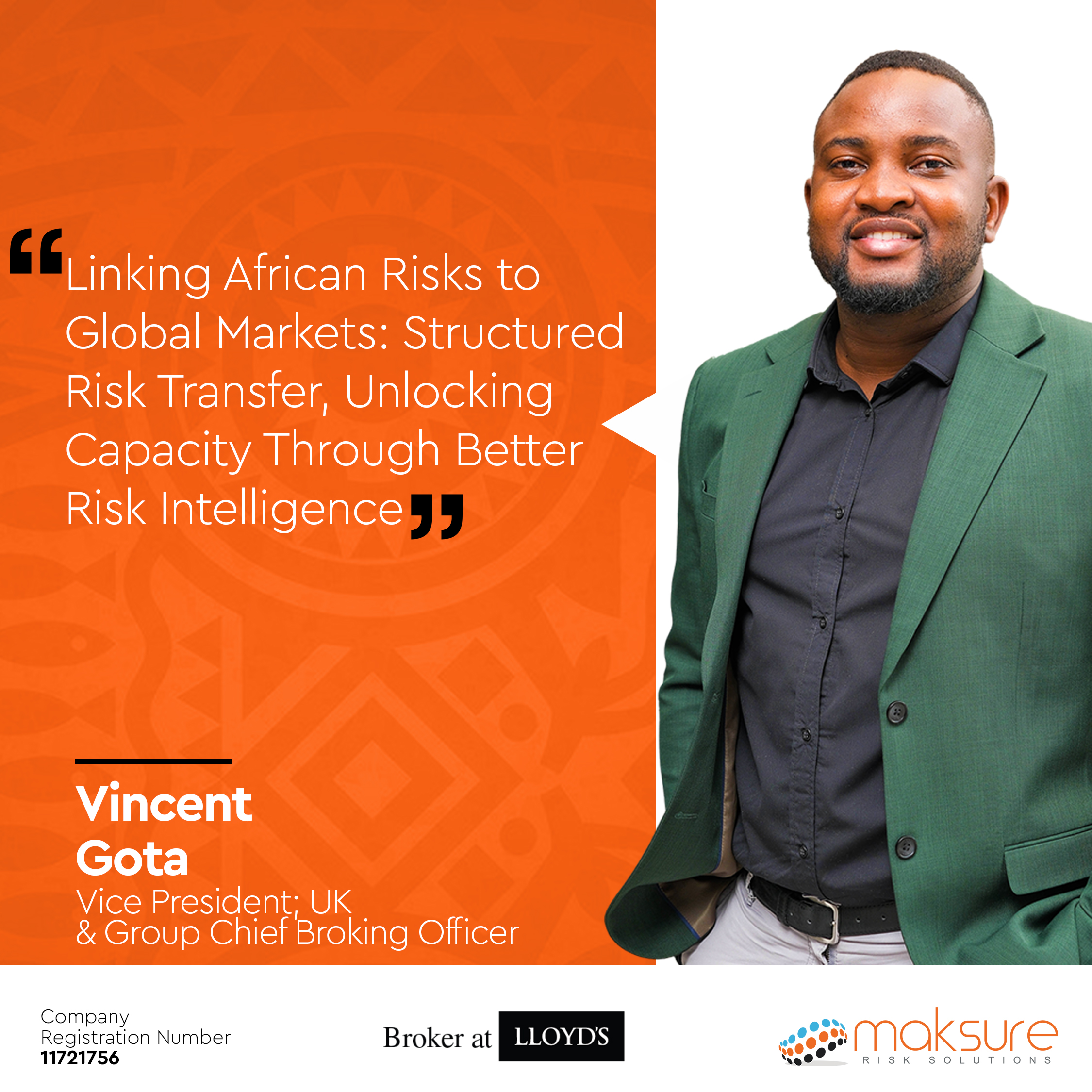
Linking African Risks to Global Markets from a London Perspective
For decades, international financial markets treated Africa primarily as a peripheral insurance territory - a region defined in underwriting circles by capacity deficits, fragmented domestic markets, and transactional risk placements. That traditional view is rapidly becoming obsolete. From the trading floors of Lime Street in London to the financial hubs of Johannesburg, Nairobi, and Lagos, Africa must now be recognised for what it truly is: one of the world’s most dynamic, high-growth specialty risk and investment frontiers.
Across the African continent, industrialisation, rapid urbanisation, massive renewable energy initiatives, critical minerals extraction, and sprawling intra-continental logistics corridors are fundamentally changing the global economic landscape. Behind every gigawatt of power added to a regional grid, every ton of exported copper or lithium, and every deepwater port expansion lies a sophisticated, multi-layered risk profile. The central strategic question facing C-suite executives, institutional investors, and global risk carriers is no longer whether Africa will generate massive demand for specialised risk-transfer solutions. The core imperative is how effectively complex African risks can be structured, translated, and connected to global insurance and reinsurance capital.
London occupies a unique position in answering this imperative. For centuries, the London Market has cultivated an extraordinary ability to bring together highly complex, non-standard risks, specialist underwriting expertise, and deep pools of international capital. Controlling approximately $187 billion in gross written premium and commanding a significant share of global commercial and specialty risk, London’s true competitive advantage lies not merely in its financial capacity, but in the dense concentration of underwriting syndicates, brokers, actuaries, risk engineers, legal specialists, and claims experts operating within its ecosystem. This unique aggregation allows London to underwrite intricate exposures that standard global models struggle to evaluate.
However, a persistent misconception in international insurance is that Africa’s primary barrier to risk transfer is a simple shortage of capital. The reality facing major commercial enterprises across the continent is far more subtle. Capital exists abundantly on global balance sheets. The true structural challenge lies in making complex African operational realities transparent, measurable, bankable, and investable for international underwriting syndicates. An underwriter sitting in London may have substantial risk capacity available, but deploying that capital requires complete confidence in the quality of data, engineering standards, loss scenario modelling, and management governance thousands of kilometres away.
This is where the traditional role of the insurance broker must undergo a radical transformation. The legacy model of risk brokerage was built around basic distribution- taking a risk submission from a client, circulating it across local or international markets, and securing the lowest possible premium rate. In today's volatile economic environment, that approach is entirely insufficient. The modern corporate risk advisor must act as a technical translator. Rather than initiating conversations with global underwriters around price, the discussion must begin with a granular technical analysis of operational resilience, supply-chain dependencies, machinery failure vulnerabilities, single points of failure, and proactive loss-mitigation frameworks.
When corporate risk strategy shifts from passive premium negotiation to active risk engineering, something profound occurs. The conversation moves from price bargaining to structural risk enhancement. For sophisticated underwriters, superior operational clarity breeds underwriting confidence, which directly yields higher capacity limits, tailored coverage terms, and long-term balance-sheet stability for the commercial client. This alignment is particularly critical when navigating the sheer geographic and economic diversity of the African continent. Treating Africa as a single, uniform risk zone is one of the most significant failures of legacy international underwriting. The operational, regulatory, and physical exposures of a commercial facility in Johannesburg are vastly different from a manufacturing hub in Lagos, an infrastructure corridor in East Africa, or a mining asset in the Copperbelt. Successful capital deployment demands the fusion of deep, on-the-ground regional intelligence with global specialty underwriting capability.
Beyond immediate balance-sheet protection, sophisticated insurance acts as a primary catalyst for economic development and foreign direct investment. Insurance is often mistakenly viewed as an administrative afterthought that merely follows capital investment. In reality, structured risk transfer frequently enables investment in the first place. Major infrastructure developments, utility-scale power projects, and resource extraction ventures require billions of dollars in debt and equity. Before institutional lenders and multinational boards commit capital, they require absolute certainty regarding financial recourse in the event of catastrophic failure or geopolitical disruption. By offloading tail risks to international reinsurance markets, structured risk transfer provides the security framework required for investors and commercial banks to deploy capital with conviction.
As Africa’s economic landscape matures, its corporate risk profile is also evolving beyond traditional property and casualty hazards. Emerging exposures such as climate volatility, complex supply-chain disruptions, and sophisticated cyber threats targeting rapidly expanding digital ecosystems require next-generation financial solutions. Modern risk structures; including trigger-based parametric insurance for rapid liquidity, structured alternative risk transfer mechanisms, political risk guarantees, and capital-market-backed catastrophe bonds - are increasingly required to protect continental growth. The ultimate objective is to build a two-way strategic corridor where African enterprises gain direct access to global capital while international syndicates benefit from non-correlated diversification and high-margin specialty asset opportunities.
Navigating this changing landscape requires executive leadership that treats risk management not as an expense, but as a core driver of corporate strategy and competitive advantage. At Maksure Risk Solutions, we build the vital bridge between African business opportunities and global capital markets, combining deep regional insight with international technical expertise to protect your balance sheet and enable sustainable growth. Contact our executive team today to schedule a consultation and transform your corporate risk framework into a powerful strategic asset.
Vincent Gota is the Vice President – United Kingdom at Maksure Risk Solutions, an independent specialist insurance and reinsurance broker operating across global markets. Based in London, Vincent leads the firm’s international placements, wholesale broking, and specialist lines growth, focusing on bridging the gap between complex African risks and global insurance capital markets.
Visit: www.maksure.co.za | Contact: info@maksure.co.za
Maksure Risk Solutions is an Afro-Global independent specialist insurance and reinsurance broker with business footprint in Africa, Asia, East & Western Europe, South America and the Caribbean. We provide innovative and tailor-made risk solutions in Insurance and Reinsurance as well as Risk Financing and Actuarial Consulting geared towards capital management and strengthening our client’s balance sheet. Maksure is also one of the major players in Captive Management (Establishment & Management) in South Africa, Mauritius, Bermuda and various other jurisdictions. We have access into the Lloyds of London with a deep understanding of African markets. Our global nature ensures that our clients access quality capacity as well as some of the world’s latest thinking and solutions.
Recent Posts

The Hidden Cost of Mining Growth Is Complexity – and How to Master It.


5 tendencias que marcarán el mercado de reaseguros en México en 2027
Beyond the Horizon: Why Port Risk Management Demands an End-to-End Supply Chain Perspective

Lo que los mercados de seguros de Sudáfrica y Méxicopueden aprender el uno del otro
One Workforce, Many Countries: Navigating Pan-African Healthcare with Strategic Precision.



Linking African Risks to Global Markets from a London Perspective