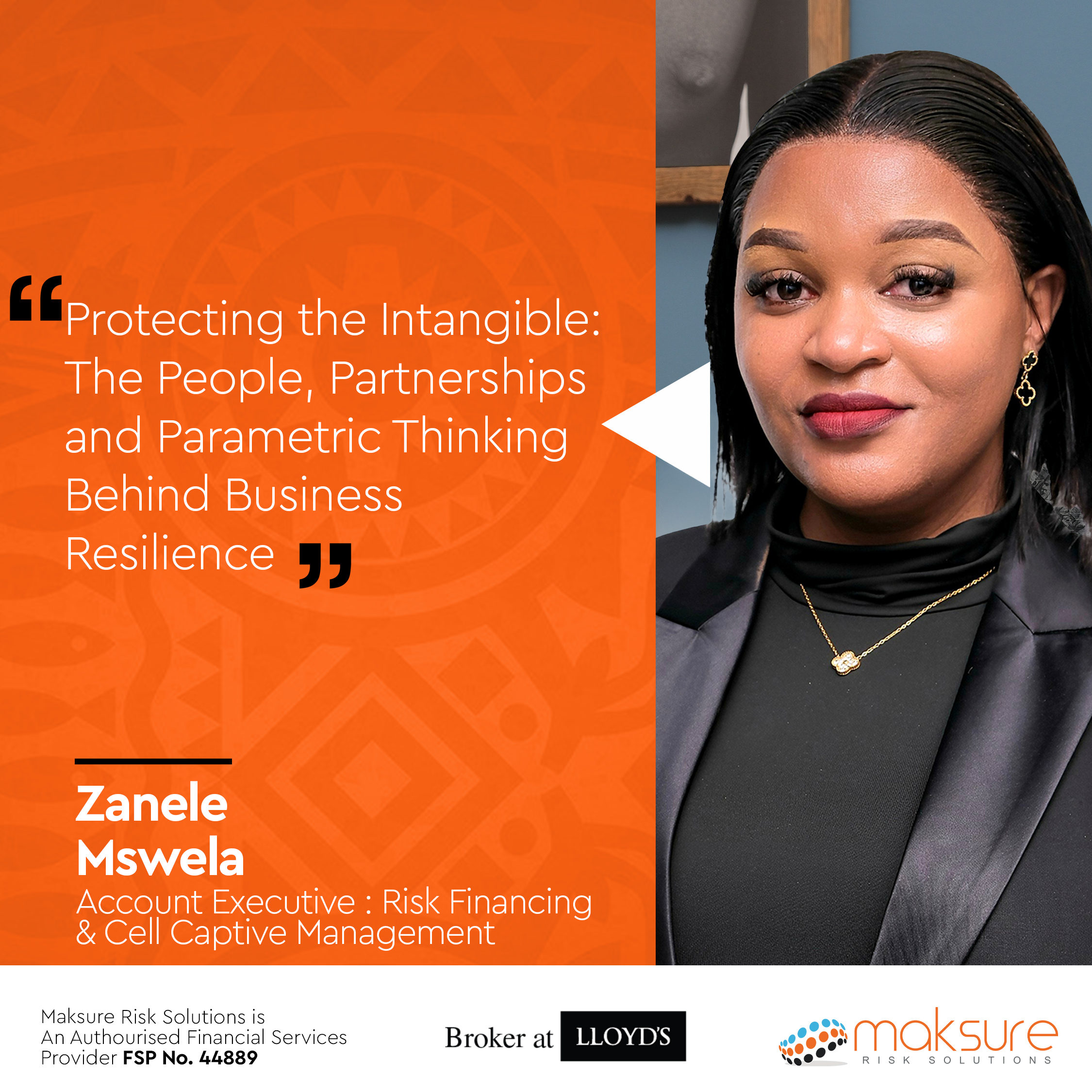
Protecting the Intangible: The People, Partnerships and Parametric Thinking Behind Business Resilience.
From tourism and solar energy to mineral processing and municipal flood recovery, protecting what a business earns matters as much as protecting what it owns.
By Zanele Mswela
A building can survive a climate event while the business inside it suffers.
A hotel may remain undamaged while cancelled bookings erode its income.
A solar installation may be fully operational yet generate less electricity because the sunlight it depends on falls below expectations.
A salt producer’s processing plant may remain standing while excessive rainfall disrupts the conditions needed for production.
These scenarios invite a different insurance question: What happens when the asset is intact, but its ability to generate income is compromised?
That question is the crux of the parametric solutions we have developing aggressively at Maksure Risk Solutions. Our development work spans solar-energy opportunities, non-indemnity business interruption protection for mining operations and production, commodity-price protection for mineral processing, and rapid flood-recovery financing for municipalities, windspeed based non indemnity parametric protection for ports. The agricultural parametric cover are now quite mature in our stables and are providing invaluable input to are data centre and calculation capacity. Each starts with a different exposure, but a shared objective: protecting financial resilience beyond physical assets.
When Physical Damage Is Not the Whole Story
Traditional business interruption insurance generally responds to income losses following insured physical damage, subject to the policy wording and any applicable extensions. However, commercial disruption does not always follow that sequence.
For tourism, hospitality and retail businesses, accessibility and destination appeal can be as important as the condition of the premises. A resort could remain operational while severe weather disrupts travel to the surrounding area. A shopping centre could escape flood damage while inaccessible roads reduce customer traffic.
Non-Physical Damage Business Interruption protection seeks to address specified exposures of this nature. Parametric insurance offers one way of structuring that protection: the contract establishes an independently measurable trigger and a predetermined payout mechanism, rather than calculating the payment through a conventional adjustment of the actual financial loss.
The distinction matters. NDBI describes the exposure being protected; parametric describes a mechanism through which protection can respond. Not every parametric product is an NDBI policy, and not every NDBI policy is parametric.
Starting With the Business, Not the Product
In our solar-energy work, the starting point has been understanding the operation: how it earns revenue, which conditions affect generation, and whether the client’s priority is production, cash-flow stability, debt repayments or investor returns. Our preliminary assessment approach deliberately places these questions before detailed product design.
This changes the conversation from “What insurance can we sell?” to “What financial consequence are we trying to protect?”
For a solar producer, reduced irradiation can affect output and revenue without damaging the panels. A suitably designed irradiation-index product can address that specific exposure, although it does not automatically protect against every cause of underperformance.
For Maksure, the important discipline is keeping the client’s commercial reality at the centre of the technical discussion. A measurable weather variable is only useful if it meaningfully relates to the financial vulnerability we are trying to address.
Critical Elements Mining: Understanding the Production Process
Our work on a proposed non-indemnity business interruption solution for a Botswana salt and soda ash producer brings this principle into sharp focus.
The operation depends on solar evaporation to concentrate brine. Excess rainfall can dilute that brine, disrupt harvesting and delay the restoration of conditions required for production. Lower temperatures can also reduce evaporation. The exposure is therefore not simply whether machinery has been damaged, but whether the production process can continue effectively.
The development discussions have progressed from an excess-rainfall concept to a refined, non-binding indication incorporating rainfall and low-temperature indices. That evolution reflects the value of continued engagement between the client, Maksure and the specialist underwriting team: understanding the operation more closely can change the proposed protection.
It also illustrates why bespoke structuring requires more than selecting a weather threshold. Seasonality, brine concentration, production recovery and the financial consequences of interruption all belong in the conversation.
Mineral Processing: Looking Beyond Weather
Our parametric work has also extended to proposed commodity-price protection for a titanium dioxide pigment project, with the aim of addressing market-price volatility and its implications for project bankability. This is a different exposure from weather-related business interruption, but it follows the same broader principle: financial performance can be threatened without physical damage to the underlying plant.
These applications should not be treated as interchangeable. A rainfall index, an irradiation index and a commodity-price index protect against different conditions and require different structures.
What connects them is the willingness to look beyond the asset schedule and examine the assumptions on which a business’s cash flow depends.
Rapid Flood Recovery: Bringing the Thinking to Cities
That same perspective becomes particularly significant at municipal level.
Our work on the eThekwini rapid flood-recovery programme has focused on a parametric excess-rainfall structure intended to provide funding following defined severe-rainfall events. The objective is to support emergency costs, service continuity and early recovery without first requiring every damaged asset to be individually valued through a conventional loss-adjustment process.
Developing the proposed programme has involved historical-event analysis, geographical mapping, alternative payout structures, capacity discussions and regulatory engagement. The April 2022 floods were used as a reference event in the development analysis, helping the teams examine how different structures might respond. These are modelled scenarios, not evidence of an actual policy payout.
For the team at Maksure, this is where the potential becomes especially compelling. Municipal resilience is not only about the eventual cost of replacing infrastructure. It is also about the ability to mobilise resources when communities need a response.
Our ambition is for this pioneering work to help shape a practical approach to disaster liquidity for other cities and metros across the region and, ultimately, Africa. That ambition must be supported by local data, appropriate contractual structures, and the requirements of each jurisdiction, rather than assuming that one city’s programme can simply be replicated elsewhere.
Where Risk Financing and Actuarial Thinking Meets Reinsurance
The collaboration behind these solutions is as important as the product concept.
In the flood programme, the working materials have brought together historical rainfall analysis, location-level mapping, alternative limits and payout scenarios, alongside discussions with international capacity providers. In our mining productions projects, client engagement has informed refinements to the proposed indices and structure.
This is the intersection of actuarial analysis, risk financing and reinsurance that our work captures seamlessly.
Actuarial thinking helps frame the relationship between the measurable event and the financial exposure. Risk-financing discussions keep attention on the liquidity the client needs and the risk it can retain and structure the parametric logic and defines reasonable independent triggers. Reinsurance engagement brings in the mega capacity for proposed structure into conversation with the markets being asked to support it where the exposure can be catastrophic.
Our experts in these discussions help connect the client’s operational concerns with the technical and commercial questions that must be resolved. The aim is not complexity for its own sake. It is a structure that the client can understand, the technical teams can explain, and the capacity providers can assess.
Innovation Requires Honest Boundaries
Parametric insurance is not a promise that every loss will be paid.
Its central limitation is basis risk: the payout may differ from the actual financial loss. A business can suffer disruption without the agreed index reaching its threshold or receive a payment that is higher or lower than the loss experienced. Careful data analysis and trigger design can help manage this mismatch but cannot eliminate it entirely.
Speed must also be described responsibly. A formula-based calculation can reduce reliance on conventional loss adjustment, but payment remains subject to the contract, the agreed data and the applicable verification requirements.
For these reasons, we see parametric protection as a powerful complement to conventional insurance and sound risk management, not a replacement for either.
Protecting the Ability to Keep Going
The thread running through these projects is not simply innovation in insurance wording. It is a broader view of what needs protecting.
For a hotel, that may be the ability to attract guests. For a solar producer, the revenue associated with a weather-dependent resource. For a mining producer, the environmental conditions that sustain production. For a municipality, access to funding that supports response and recovery. For a State run Motor Third Party liability fund, how many fatal car crashes start to destabilise the Fund’s future ability to cover its claims
At Maksure, our ambition is to bring client understanding, actuarial insight, risk-financing expertise and international insurance and reinsurance capacity into the same conversation.
Because resilience is not only about whether the building survives. It is about whether the business, the city and the communities that depend on them can keep going.
Zanele Mswela (FIISA, AIRMSA) is an Account Executive in Risk Financing & Captive Management at Maksure Risk Solutions. She supports clients in developing tailored captive and risk-financing approaches to fund and manage their exposures, with the aim of improving cost efficiency, control over insurance programmes, and risk-bearing capacity.
Visit: www.maksure.co.za | Contact: info@maksure.co.za
Maksure Risk Solutions is an Afro-Global independent specialist insurance and reinsurance broker with business footprint in Africa, Asia, East & Western Europe, South America and the Caribbean. We provide innovative and tailor-made risk solutions in Insurance and Reinsurance as well as Risk Financing and Actuarial Consulting geared towards capital management and strengthening our client’s balance sheet. Maksure is also one of the major players in Captive Management (Establishment & Management) in South Africa, Mauritius, Bermuda and various other jurisdictions. We have access into the Lloyds of London with a deep understanding of African markets. Our global nature ensures that our clients access quality capacity as well as some of the world’s latest thinking and solutions.
Recent Posts




Maksure UK Expands into Corporate and Public Sector Insurance Broking.
Elevating Municipal Resilience: A Strategic Framework for Claims Risk Management.

The Hidden Cost of Mining Growth Is Complexity – and How to Master It.


5 tendencias que marcarán el mercado de reaseguros en México en 2027