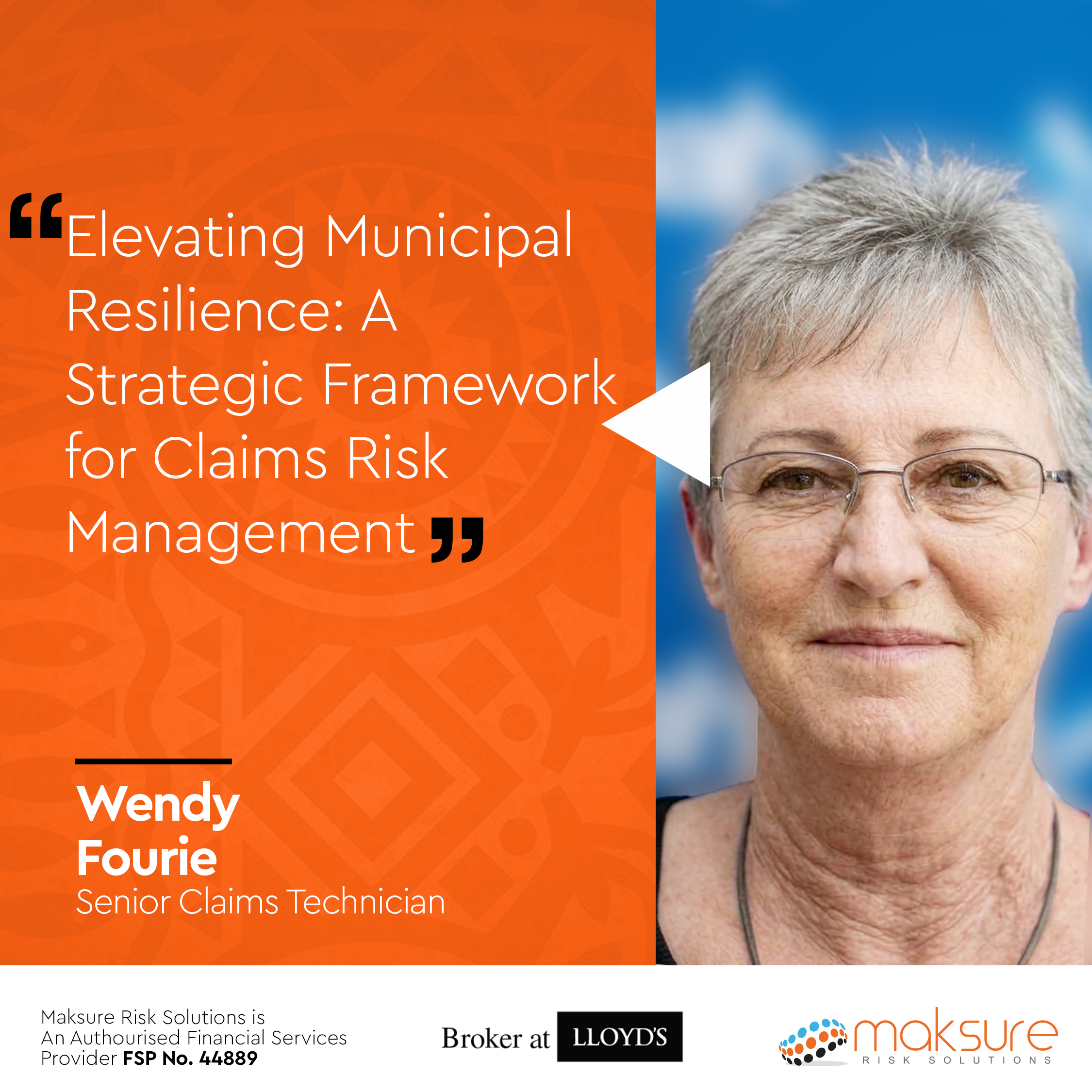
Elevating Municipal Resilience: A Strategic Framework for Claims Risk Management.
Moving Beyond Reactive Litigation
In today’s municipal operating environment, claims risk is no longer merely a localised legal burden or an isolated insurance administration exercise. Today, public liability claims serve as a direct, highly visible barometer of municipal health - reflecting overall infrastructure integrity, operational discipline, financial stewardship, and governance maturity.
From deteriorating road networks and water infrastructure failures to illegal electrical connections and service delivery disruptions, unmanaged public liability exposures threaten to drain scarce operating capital. Beyond the direct costs of payouts, unchecked claims inflict compounding harm in legal fees, default judgment interest, adverse court rulings, and severe reputational damage.
The contemporary local government risk landscape is further compounded by aging infrastructure, constrained capital maintenance budgets, siloed internal operations, and fragmented claim ownership. When critical evidence; such as incident reports, work orders, maintenance logs, inspection records, and geolocated imagery - cannot be rapidly retrieved, even legally defensible matters become exceptionally costly or impossible to defend. Worse still, delayed internal routing of court documents exposes municipalities to preventable default judgments before the substantive legal merits can even be evaluated.
Key Strategic Imperatives
- Claims as Strategic Intelligence: Claims data must be leveraged as an operational early-warning system to pinpoint recurring infrastructure and service bottlenecks.
- Rapid Response as a Core Defence: Accelerated notification, rigorous evidence preservation, and singular case ownership dramatically enhance the strength of municipal legal defences.
- Unified Governance: Long-term risk reduction requires breaking down departmental silos to unite Legal, Risk, Operations, Engineering, and Finance within an integrated control framework.
By shifting from a reactive claims posture to a proactive, evidence-led risk model, municipal leadership can safeguard fiscal sustainability, distinguish isolated incidents from systemic risks, direct capital to high-risk exposures, and settle valid matters before legal costs escalate unnecessarily.
High-Risk Exposure Domains in Local Government
1. Roads, Sidewalks & Public Spaces
Potholes, road edge degradation, missing manhole covers, and unmaintained sidewalks remain persistent drivers of vehicular damage and personal injury claims. Legal exposure is governed not only by the physical presence of a defect, but by what the municipality knew or reasonably ought to have known, how repairs were prioritised, and whether adequate interim warnings or safety measures were deployed pending permanent remediation.
2. Water, Sanitation & Stormwater Systems
Burst pipes, sewer surcharges, blocked stormwater drainage, and system overflows frequently cause extensive damage to private properties and municipal assets. Systemic failures in recurring locations require integrated call-centre logs, formal complaint records, and work-order histories to substantiate reasonable operational response times and defeat allegations of negligence.
3. Electricity Infrastructure & Illegal Connections
Exposed live conductors, unlawful grid connections, and compromised distribution networks pose critical life safety, fire, and property damage hazards. Unauthorised reconnections occur swiftly; disconnection alone does not constitute a complete control measure. Municipalities require a multi-agency strategy linking technical units, community safety teams, and law enforcement, all supported by documented inspection logs and swift escalation procedures.
4. Service Outages & Consequential Loss
Extended utility and service interruptions increasingly trigger commercial business interruption claims, contractual disputes, and public-law challenges. Even when liability is vigorously contested, gaps in incident logging, weak communication protocols, and inaccurate restoration timelines magnify both financial exposure and reputational harm.
Diagnosing Process Failures in Municipal Defence
Traditional municipal claim management models frequently falter due to structural process bottlenecks. The primary structural weaknesses that compromise municipal legal standings include:
- Ingestion Delays: Delayed internal escalation of letters of demand, combined with late forwarding of court summonses to legal advisors and insurers.
- Evidentiary Gaps: Incomplete or missing photographic evidence, maintenance histories, sign-off logs, and proof of remedial actions.
- Siloed Ownership: Ambiguity between Legal Services, Engineering/Public Works, Finance, Risk Management, and external insurance partners regarding case ownership.
- Slow Technical Feedback: Protracted response times from technical departments when requested for site reports or expert witness statements.
- Lack of Central Visibility: The absence of a single, centralized register tracking litigation deadlines, potential reserves, trial outcomes, and root-cause trends.
A Strategic Claims Defence & Mitigation Framework
To establish a defensible, resilient claims posture, municipalities must operationalise a structured, five-stage framework that flows sequentially from initial incident ingestion to root-cause prevention:
Stage 1: Controlled Intake & Triage
Establish a mandatory, centralised intake process for all claims, formal demands, and legal papers on the exact date of receipt. Triage each matter immediately based on severity, statutory deadlines, potential financial exposure, and public safety implications, escalating urgent matters to Legal, Engineering, Finance, and Risk teams simultaneously.
Stage 2: Standardised Evidence Curation
For every incident, open a standard evidence pack immediately. Complete the public liability claim documentation and lodge it alongside the formal demand letter with your risk transfer partner or insurer without delay. Ensure each file contains the initial incident report, accurate dates and coordinates, site photographs, pre-incident complaint logs, contractor work orders, and subsequent maintenance records.
Stage 3: Objective Liability & Quantum Assessment
Collaborate across technical and legal disciplines to evaluate duty of care, alleged breach, proximate causation, and potential contributory negligence. The objective is not to litigate every matter unconditionally, but to distinguish merits-based defences from matters requiring swift, cost-effective early resolution. Document formal recommendations covering liability prospects, reserve requirements, and settlement authorities.
Stage 4: Active Litigation Management
Maintain structured, continuous oversight over appointed legal counsel and municipal departments. Enforce strict performance standards, regular milestone monitoring, and proactive follow-ups to keep proceedings moving forward efficiently.
Stage 5: Root-Cause Elimination
Close the loop by feeding claim outcomes back into operational departments. Where a claim stems from physical infrastructure defects or operational gaps, mandate corrective technical action to eliminate the underlying hazard and prevent repeatable loss.
Core Best Practices for Operational Transformation
Transforming municipal claims risk requires migrating from a reactive, file-by-file mindset toward an institutionalized prevention and defence ecosystem:
- Establish Clear Governance Frameworks: Formally approve a comprehensive claims governance policy detailing delegation thresholds, investigation SLAs, defence protocols, and operational escalation paths.
- Enforce Strict Service Level Agreements: Implement mandatory same-day logging for all formal legal papers, defined turnarounds for technical evidence generation, and strict follow-up mechanisms for overdue departmental inputs.
- Integrate Operational & Financial Data Systems: Connect claims registers directly with customer relationship management (CRM), GIS mapping, asset management databases, and municipal finance platforms to illuminate exposure hot spots.
- Drive Evidence-Led Risk Prevention: Harness claim metrics, location density, and severity trends to prioritise capital spend, target preventative maintenance schedules, and implement immediate temporary safety interventions.
The Strategic Value Partner Advantage
Navigating complex municipal liability requires more than standard insurance placing, it demands an integrated, end-to-end risk and advisory partner.
As a trusted partner in public sector risk management, Maksure Risk Solutions delivers specialised expertise designed specifically for local government realities:
- End-to-End Claims Oversight: We bridge the critical gap between municipal technical departments, internal legal teams, and external legal representatives, streamlining the flow of technical evidence and ensuring legal deadlines are met.
- Advanced Risk Transfer & Structuring: Designing bespoke public liability and asset risk transfer solutions tailored to municipal budget frameworks and risk profiles.
- Data-Driven Loss Control & Root-Cause Analytics: Leveraging claims analytics to assist municipal executives in identifying systemic failure modes, prioritising high-risk infrastructure corridors, and implementing proactive risk controls.
- Governance & Capacity Building: Assisting municipalities in designing defensible claims SOPs, delegations’ frameworks, and evidence-management workflows that strengthen municipal legal standing and protect public funds.
Strategic Outlook
Effective municipal claims management extends well beyond the legal department. Public liability exposures are a direct reflection of how municipal infrastructure, service operations, administrative controls, and community communications interact.
By instituting centralised oversight, enforcing immediate evidence curation, and utilising loss data to drive capital maintenance, municipal leadership can protect scarce financial resources, enhance legal success rates, and ultimately deliver reliable, resilient public services.
Wendy Fourie is a Senior Claims Technician at Maksure Risk Solutions with over 40 years of specialised experience in corporate and public sector insurance claims. Wendy spent three decades managing complex corporate portfolios before dedicating her expertise to local government risk management. Having managed portfolios for up to 16 municipalities, Wendy brings deep technical precision and operational continuity to her current role overseeing liability and motor claims for the Metropolitan Municipalities.
Maksure Risk Solutions is an Afro-Global independent specialist insurance and reinsurance broker with business footprint in Africa, Asia, East & Western Europe, South America and the Caribbean. We provide innovative and tailor-made risk solutions in Insurance and Reinsurance as well as Risk Financing and Actuarial Consulting geared towards capital management and strengthening our client’s balance sheet. Maksure is also one of the major players in Captive Management (Establishment & Management) in South Africa, Mauritius, Bermuda and various other jurisdictions. We have access into the Lloyds of London with a deep understanding of African markets. Our global nature ensures that our clients access quality capacity as well as some of the world’s latest thinking and solutions.
Recent Posts
Elevating Municipal Resilience: A Strategic Framework for Claims Risk Management.

The Hidden Cost of Mining Growth Is Complexity – and How to Master It.


5 tendencias que marcarán el mercado de reaseguros en México en 2027

Beyond the Horizon: Why Port Risk Management Demands an End-to-End Supply Chain Perspective

Lo que los mercados de seguros de Sudáfrica y Méxicopueden aprender el uno del otro

One Workforce, Many Countries: Navigating Pan-African Healthcare with Strategic Precision.