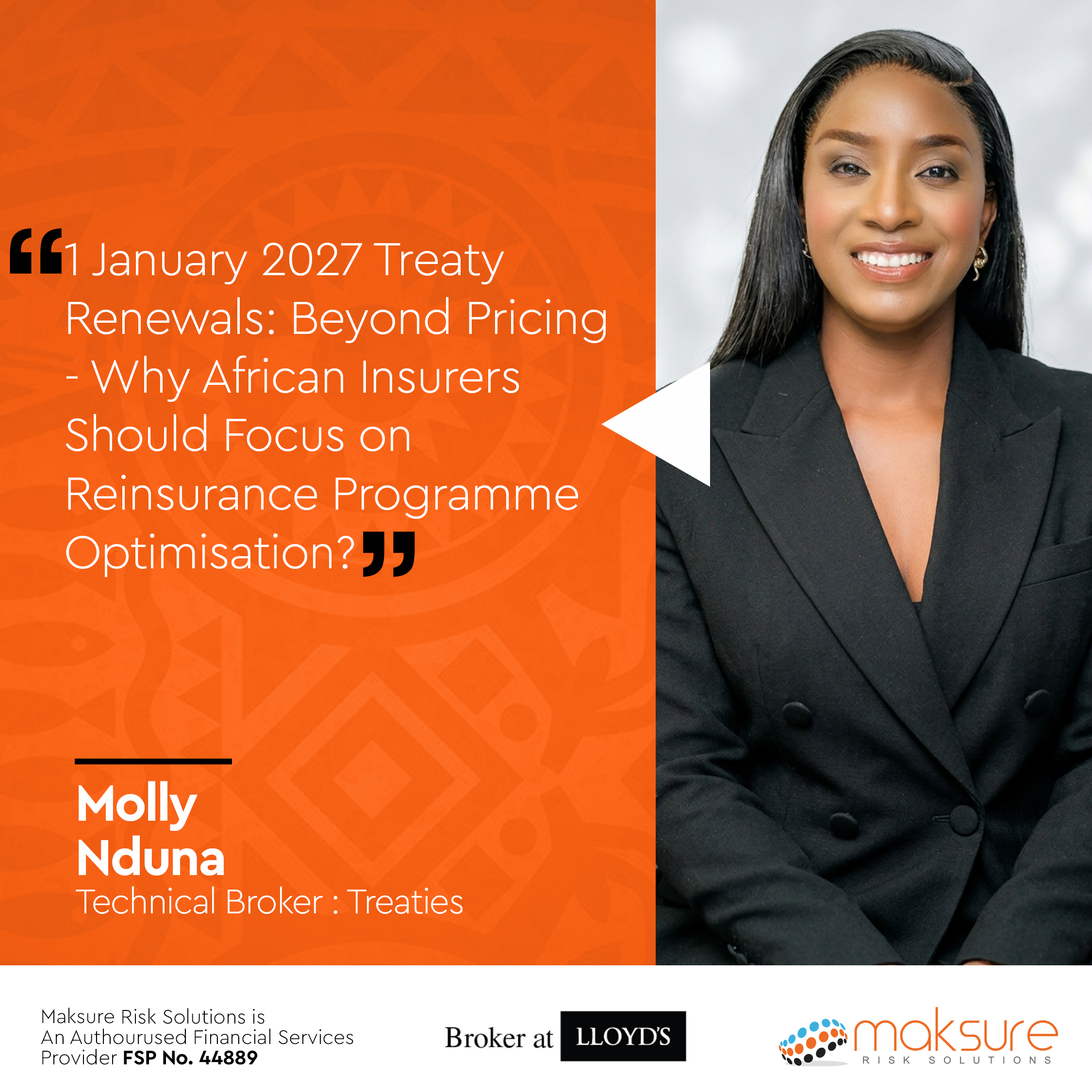
1 January 2027 Treaty Renewals: Beyond Pricing – Why African Insurers Should Focus on Reinsurance Programme Optimisation?
As African insurers prepare for the 1 January 2027 treaty renewal season, the conversation should move beyond one question: “How much cheaper can we buy our reinsurance?”
A more important question is:
“How can we use current market conditions to build a stronger and more efficient reinsurance programme?”
A Softening Market Presents an Opportunity Beyond Pricing
The approaching 1 January 2027 treaty renewal environment presents an important strategic opportunity for African insurers to look beyond pricing and critically reassess the structure and effectiveness of their reinsurance programmes.
Improving capacity and competitive conditions across various segments of the international reinsurance market provide greater scope to revisit not only pricing, but also retentions, limits, coverage, treaty wording and overall programme design.
For African insurers, this is particularly important. Portfolios are evolving, insured values are changing, claims costs continue to develop, and insurers are pursuing growth across increasingly complex risks.
At Maksure Risk Solutions, we believe the real value of the 2027 renewal therefore lies not simply in securing lower reinsurance costs but centred on reinsurance programme optimisation to ensure that the programme remains aligned with the insurer's risk appetite, capital position, evolving exposure profile and future business strategy.
A simple principle should guide the renewal:
‘’Don't simply renew last year's programme. Use the renewal to determine whether it is still the right programme.’’
As an established reinsurance broking player in Southern Africa, with direct access to Lloyd's of London and international reinsurance markets, Maksure is working with African cedants to leverage current market conditions to achieve meaningful improvements in their treaty structures.
1. Reinsurance Optimisation: A More Strategic Approach
Reinsurance programmes naturally evolve from one renewal to the next. Retentions are carried forward, limits are adjusted, capacity is renewed and pricing is renegotiated.
However, the underlying insurance portfolio does not remain static.
Premium income changes. Insured values increase. Claims experience develops. Inflation affects loss severity. New classes of business are introduced. Accumulations change, and insurers' capital positions and strategic objectives evolve.
As a result, a treaty structure that was appropriate several years ago may no longer represent the most effective use of reinsurance capital today.
Rather than automatically renewing historical arrangements, insurers should periodically step back and ask:
“If we were designing this reinsurance programme from the ground up today, would we structure it in exactly the same way?”
At Maksure Risk Solutions, this question is central to our approach to reinsurance programme optimisation.
Through our Reinsurance Optimisation Model, we work with insurers to reassess existing treaty structures against their current exposures, loss experience, risk appetite and strategic objectives. The focus is not simply on renewing capacity or negotiating pricing, but on determining whether the structure itself remains appropriate for the risks being transferred.
Designed specifically for the requirements and operating environments of African insurers, the model combines actuarial analysis, portfolio risk assessment, programme structuring and international reinsurance market intelligence to identify reinsurance arrangements that are appropriate to each cedant’s risk profile, capital position and strategic objectives.
Our optimisation process considers several fundamental questions:
- Is the insurer retaining an appropriate level of risk relative to its capital position, financial strength and risk appetite?
- Are treaty attachment points, limits and layers aligned with the insurer’s current exposure and loss profile?
- Does the programme provide appropriate protection against large individual losses, catastrophe events and earnings volatility?
- Can the treaty structure be redesigned to release underwriting capacity and support sustainable, profitable growth?
- Do existing treaty wordings create gaps, ambiguities or unintended retained exposures that could affect the insurer when a loss occurs?
By addressing these questions collectively, Maksure moves the renewal discussion beyond pricing and capacity towards the overall effectiveness of the reinsurance programme, ensuring that the structure remains aligned with the cedant’s evolving exposures and business objectives.
Ultimately, every dollar of reinsurance expenditure should have a clear purpose and deliver measurable value in protection, capital efficiency and underwriting capacity.
2. Restructuring Non-Proportional Treaty Attachment Points
One of the most significant opportunities during the 2027 renewal season lies in the restructuring of non-proportional reinsurance programmes.
For many African insurers, excess-of-loss attachment points have remained relatively unchanged despite shifts in portfolio composition, inflation, claims experience and capital strength.
A softening market provides an opportunity to revisit these structures.
Through actuarial modelling and loss distribution analysis, Maksure assists cedants in evaluating alternative retention levels, attachment points, layer limits and reinstatement provisions.
For some cedants, reducing an attachment point may provide greater protection against earnings volatility. For others, retaining a greater proportion of predictable losses while purchasing additional protection against severe events may produce a more efficient economic result. There is no single structure that is appropriate for every insurer.
The optimal structure depends on the insurer's financial strength, risk appetite, expected loss experience and the marginal cost of transferring risk.
Existing treaty limits should also be assessed against realistic loss scenarios to determine whether they remain adequate as exposures evolve.
Ultimately, the objective is to optimise the programme rather than simply minimise cost or maximise the amount of cover purchased. This means securing protection at the appropriate attachment points and across the right layers, aligned with the risks the insurer actually carries.
3. Strengthening Treaty Wordings and Negotiating Broader Coverage
Treaty reinsurance negotiations often place significant emphasis on rates, commissions and capacity, while insufficient attention is given to the underlying contract wording.
Yet the true value of reinsurance is ultimately determined by how the treaty responds to a loss.
Maksure is placing particular emphasis on reviewing treaty wordings and negotiating meaningful coverage enhancements during the 2027 renewal discussions.
Areas of focus include:
- Broader event definitions and hours clauses for catastrophe exposures.
- Improved reinstatement provisions and associated premium terms.
- Appropriate treatment of emerging risks and new classes of business.
- Review of exclusions, sub limits and coverage restrictions.
- Greater contractual clarity around claims cooperation, settlements and aggregation.
- Alignment between original policy coverage and reinsurance protection to minimise unintended gaps.
Where appropriate, we are also seeking extensions that respond to the evolving risk landscape facing African insurers, including climate-related exposures, infrastructure risks and emerging industrial activities
A reduction in reinsurance pricing means little if the treaty fails to respond adequately to a major claim.
For this reason, wording enhancement remains a central pillar of Maksure's renewal strategy.
4. Actuarial Capability at the Centre of Treaty Structuring
Effective treaty optimisation requires more than market negotiation. It requires a rigorous understanding of the cedant's underlying risk portfolio.
Maksure's actuarial capabilities support our treaty broking teams in evaluating programme performance and designing technically sound reinsurance structures.
Our analytical approach incorporates:
- Historical claims experience and loss development analysis.
- Probabilistic assessment of large losses and catastrophe exposures.
- Retention and attachment point optimisation.
- Modelling of expected recoveries under alternative treaty structures.
- Assessment of earnings volatility and capital implications.
- Cost-benefit analysis of proportional and non-proportional arrangements.
- Stress testing against severe but plausible loss scenarios.
This actuarial-led approach by Maksure is not simply to produce a technically sophisticated model.
It is to support better commercial decisions.
A cedant should understand why it is retaining a particular amount, why it is purchasing a particular layer and what financial outcome it expects the programme to achieve.
This also allows treaty negotiations to be supported by a stronger technical rationale.
Rather than simply approaching the market for better terms, Maksure works with the insurer to develop and present technically substantiated treaty structures that reflect the underlying portfolio, loss experience and risk profile. This enables us to engage reinsurers with a clear rationale for the proposed structure, strengthening renewal negotiations and supporting more appropriate terms and capacity.
Importantly, actuarial analysis allows insurers to distinguish between a treaty that appears inexpensive and one that delivers genuine economic value.
5. Supporting African Insurers' Growth Ambitions
Maksure views treaty reinsurance as more than a balance-sheet protection mechanism.
Properly structured, it can become a strategic enabler of business expansion.
African insurance markets continue to present significant opportunities for growth, particularly across infrastructure, energy, mining, agriculture, transport and emerging commercial risks.
As insurers pursue these opportunities, their reinsurance arrangements must evolve alongside adequate underwriting capacity and appropriately structured reinsurance arrangements.
Through our international market access, technical broking expertise and actuarial capabilities, we assist insurers in developing programmes that support new product development, larger underwriting lines, improved capital utilisation and entry into emerging risk segments.
Our approach also includes evaluating proportional treaty arrangements, including quota share and surplus structures, to determine whether existing cessions, commissions and capacity allocations remain commercially appropriate.
The 2027 renewal season provides an opportunity for cedants to align their reinsurance purchasing strategies with their broader business plans.
6. Maksure's Position in the Southern African Reinsurance Market
Maksure has established itself as a significant reinsurance broking participant in Southern Africa, supporting insurers with treaty structuring, facultative placements, actuarial analysis and access to international reinsurance capacity.
As an African-founded, accredited Lloyd's broker headquartered in London, with operations across key African markets, Maksure combines an understanding of local insurance operating environments with access to global underwriting expertise.
Our competitive advantage lies in bringing together three critical capabilities:
Local market understanding: Knowledge of African insurance portfolios, regulatory environments, catastrophe exposures and the commercial realities facing regional insurers.
International market access: Relationships with Lloyd's syndicates and global reinsurers, enabling cedants to access diversified capacity and innovative reinsurance structures.
Technical and actuarial expertise: Analytical capabilities that support evidence-based programme design, pricing evaluation and retention optimisation.
This integrated approach positions Maksure to assist insurers not only during annual renewals but throughout the reinsurance programme lifecycle.
Looking Ahead: Making the 2027 Renewals Count
As negotiations for the 1 January 2027 treaty renewals gather momentum, African insurers should resist the temptation to measure renewal success solely by the percentage reduction in reinsurance premiums.
The more important questions are:
- Does the programme provide the right level of protection?
- Is the insurer retaining the right amount of risk?
- Are the attachment points and limits still appropriate?
- Does the wording adequately reflect the underlying business?
- Is the reinsurance panel appropriately diversified and secure?
- Does the programme provide sufficient capacity for the insurer's future growth plans?
- And will the programme respond as intended when the insurer needs it most?
At Maksure, we believe that the current market environment presents an opportunity for African cedants to make structural improvements that could deliver value well beyond the 2027 underwriting year.
Our message is straightforward:
Don't simply renew the programme. Re-engineer it where the economics and risk profile justify doing so.
Because ultimately, the best reinsurance programme is not necessarily the cheapest.
It is the programme that places the right risk, in the right structure, at the right retention, with appropriate security and wording, at an economically efficient cost.
Mollin Nduna is a Technical Broker for Treaties at Maksure Risk Solutions, supporting the structuring and placement of treaty reinsurance solutions aligned with clients’ risk financing needs.
Visit: www.maksure.co.za | Contact: info@maksure.co.za
Maksure Risk Solutions is an Afro-Global independent specialist insurance and reinsurance broker with business footprint in Africa, Asia, East & Western Europe, South America and the Caribbean. We provide innovative and tailor-made risk solutions in Insurance and Reinsurance as well as Risk Financing and Actuarial Consulting geared towards capital management and strengthening our client’s balance sheet. Maksure is also one of the major players in Captive Management (Establishment & Management) in South Africa, Mauritius, Bermuda and various other jurisdictions. We have access into the Lloyds of London with a deep understanding of African markets. Our global nature ensures that our clients access quality capacity as well as some of the world’s latest thinking and solutions.
Recent Posts

What South African and Mexican Insurance Markets Can Learn from Each Other.

How Maksure Risk Solutions Adds Value in Underground Mining

The Cost of Longevity: Redefining Pension Resilience and Employee Benefit Strategy


México – Londres:ampliando el acceso a capacidad de seguros especializados