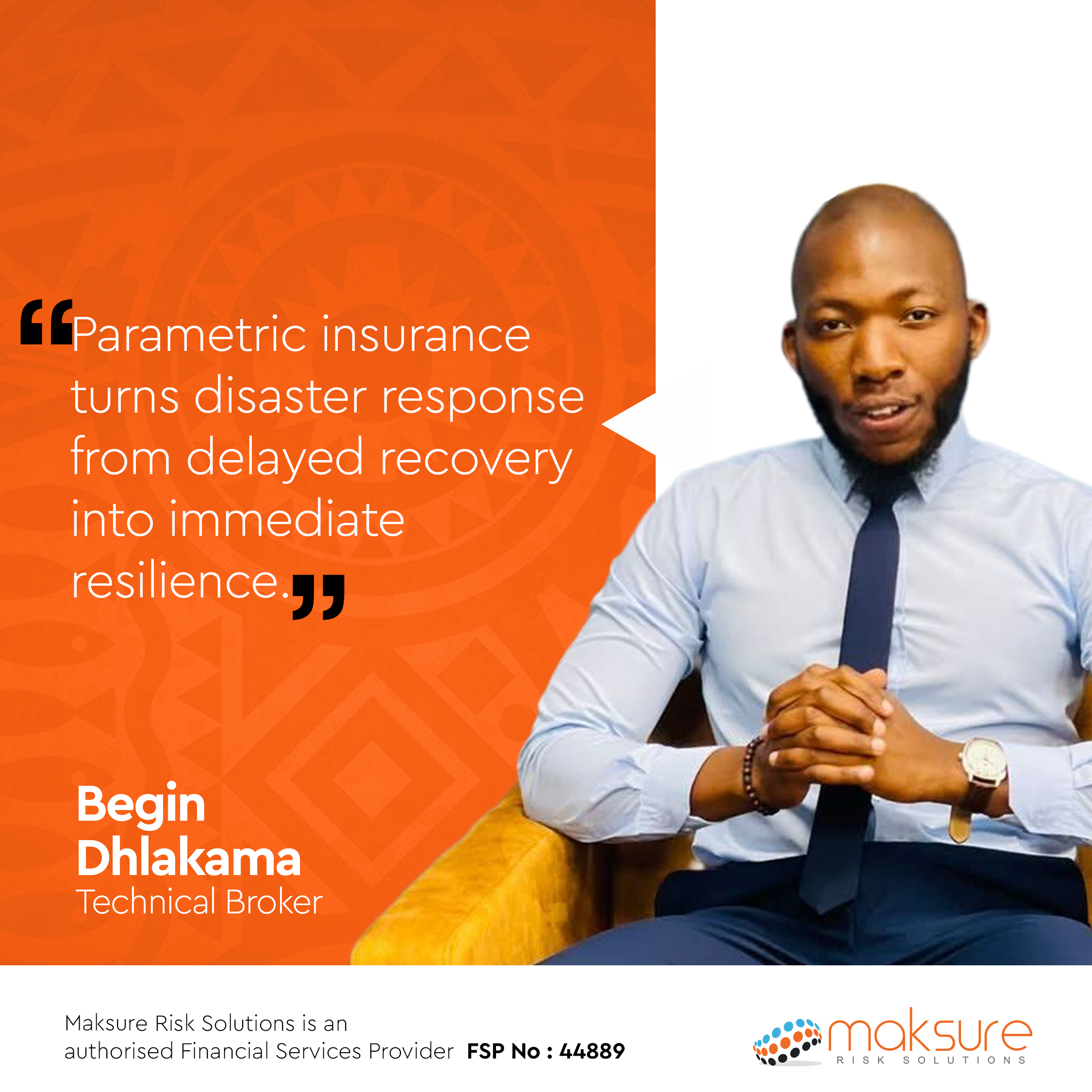
Fast, Predictable, and Resilient: How Parametric Insurance is Closing Africa’s Protection Gaps.
What happens when a climate catastrophe strikes, but the financial recovery takes months to trickle through traditional insurance adjustment processes?
In emerging and catastrophe-exposed markets - particularly across Africa - this processing delay remains one of the greatest obstacles to true disaster recovery. As climate risks intensify, relying solely on legacy indemnity structures is no longer enough. Decision-makers need speed, certainty, and immediate liquidity to protect infrastructure, sustain economies, and safeguard livelihoods.
Parametric insurance is moving from a niche alternative to a strategic imperative. Unlike traditional insurance, which requires lengthy, post-event loss assessments, parametric solutions deploy pre-agreed payouts triggered by objective, verifiable data -such as specific wind speeds, millimetres of rainfall, or earthquake magnitudes.
When the trigger is met, the capital flows. No delays, no protracted disputes; just rapid liquidity when it matters most.
Redefining Climate Resilience Across Emerging Markets
Across the continent and other high-risk regions, parametric structures are already proving their worth as indispensable disaster risk financing tools.
- Sovereign-Level Protection: Multi-country risk pools like the African Risk Capacity (ARC) have demonstrated how sovereign parametric policies can change the trajectory of disaster management. Countries such as Zimbabwe, Malawi, Mozambique, and Somalia have utilised rapid parametric payouts to fund early response efforts long before international aid or traditional claims could materialise.
- The Caribbean Precedent: Similarly, the Caribbean Catastrophe Risk Insurance Facility (CCRIF SPC) has consistently provided member states with immediate liquidity following devastating hurricanes and excess rainfall events, keeping essential government services running.
Unlocking the African Agricultural Opportunity
The strategic value of parametric insurance is perhaps most compelling within Africa’s agricultural sector. Agriculture remains the backbone of our continental economy, yet millions of smallholder farmers and agribusinesses face unmitigated exposure to severe droughts and erratic weather patterns.
Traditional indemnity insurance has historically struggled to serve this segment. Fragmented risks, a lack of localised historical data, and the high operational costs of sending loss adjusters to remote, distributed farms have created a persistent protection gap.
Parametric and index-based solutions solve this scalability challenge. By linking coverage directly to observable satellite and climate data rather than individual farm-by-farm assessments, the model reduces administrative friction and accelerates claims processing. This ensures that agribusinesses and smallholders receive funding in time to salvage the next planting season.
Lessons from Home: The Cost of Delay
The urgency for these structures is hitting closer to home. Reflecting on the devastating 2022 KwaZulu-Natal floods in South Africa, extreme rainfall caused unprecedented infrastructure damage, resulting in insured losses exceeding R15 billion according to the South African Insurance Association (SAIA).
Beyond the staggering financial toll, the event served as a stark reminder of how easily severe weather can overwhelm traditional claims supply chains, trapping corporate and municipal entities in recovery gridlock.
As technology advances - driven by sophisticated satellite imagery, geospatial analytics, and high-resolution climate modelling - the accuracy and scalability of these parametric models are improving rapidly. This is allowing us to move beyond sovereign risk and design customised corporate solutions for commercial agriculture, infrastructure, energy assets, and complex supply chains.
Navigating Basis Risk: It is important to acknowledge that parametric insurance requires technical precision. The primary challenge remains basis risk - the potential mismatch between the triggered payout and the actual losses on the ground. Mitigating this requires world-class data integrity, rigorous trigger calibration, and deep regional expertise.
The Maksure Advantage: Bridging the Gap
Parametric insurance is not a replacement for traditional indemnity coverage; it is a powerful complement. By blending the deep capacity of traditional reinsurance with the speed of parametric triggers, organisations can build a holistic, multi-layered risk management strategy.
At Maksure Risk Solutions, we sit at the intersection of international capital markets and local African realities. As a pioneering Afro-global insurance and reinsurance broker, we specialise in structuring sophisticated parametric solutions tailored to the unique risk profiles of corporate clients, state-owned enterprises, and governments across the continent.
Our deep technical expertise in data analytics, combined with our strong relationships with global top-tier reinsurers, allows us to meticulously calibrate triggers that minimise basis risk and maximise financial resilience. We do not just broker cover; we design the financial safety nets that keep African businesses moving forward, no matter the weather.
Build a Resilient Future
Do not let traditional claims timelines compromise your operational continuity. Partner with our specialist structured risk team to explore how parametric insurance can fortify your risk portfolio.
About the Author
Begin Dhlakama is a Technical Broker at Maksure Risk Solutions, specialising in servicing the UK and international insurance markets. Operating at the critical intersection of global capital and continental risk, Begin designs and places complex, structured insurance solutions tailored to the unique realities of African economies.
With deep technical expertise in catastrophe risk financing, cross-border placements, and emerging risk transfer mechanisms like parametric structures, he helps corporate clients, state-owned entities, and governments build long-term financial resilience against evolving climate realities.
Recent Posts

The Hidden Cost of Mining Growth Is Complexity – and How to Master It.


5 tendencias que marcarán el mercado de reaseguros en México en 2027

Beyond the Horizon: Why Port Risk Management Demands an End-to-End Supply Chain Perspective

Lo que los mercados de seguros de Sudáfrica y Méxicopueden aprender el uno del otro

One Workforce, Many Countries: Navigating Pan-African Healthcare with Strategic Precision.



Linking African Risks to Global Markets from a London Perspective