The Strategic Importance of Political Violence & Terrorism Insurance
In today’s increasingly volatile global macroeconomic climate, corporate leaders are navigating an intricate risk landscape that extends far beyond conventional operational exposures like fire, theft, or localised accidental damage. Across the African continent and globally, shifting socio-economic dynamics, civil unrest, labour strikes, and politically motivated disruptions have transitioned from rare anomalies to predictable line items on corporate risk registers. For C-suite executives and risk managers, these disruptions can halt operations overnight, triggering severe asset degradation, supply chain failure, and catastrophic revenue losses.
While the geopolitical triggers behind these events remain largely outside a business’s control, their financial impact on your balance sheet does not have to be. Integrating specialised Political Violence and Terrorism (PVT) insurance into a corporate risk management framework is no longer merely a compliance exercise; it is a core pillar of strategic business resilience.
Deconstructing the Risk: The Anatomy of PVT Cover
Standard commercial asset policies are fundamentally unequipped to handle systemic civil disruption. Most property and business interruption policies explicitly exclude damage arising from social or political volatility. This is where specialised PVT structures step in, systematically bridging the insurance gap for losses stemming from civil disruption, including riots, strikes, civil commotion, and public disorder. These policies also cover targeted malice, such as malicious damage, sabotage, and politically motivated violence, alongside sovereign and asymmetric threats like acts of terrorism, insurrections, and coups d'état.
Within South Africa, these exposures are primarily underwritten by SASRIA (South African Special Risks Insurance Association). As a state-owned entity, SASRIA provides a vital safety net, absorbing special risks that commercial insurers exclude. However, assuming standard SASRIA coupons automatically cover every facet of a sophisticated risk profile is a dangerous oversight. Navigating the limits, sub-limits, and structuring of this cover requires expert advisory to ensure no hidden gaps remain.
Beyond Brick and Mortar: The Total Human and Operational Impact
The visual aftermath of civil unrest; destroyed warehouses, burnt fleets, and looted retail centres - only tells half the story. The prolonged operational and psychological fallout can be far more damaging to an enterprise's long-term viability, as total enterprise loss is a combination of direct asset damage, extended business interruption, and human capital trauma.
True organisational resilience accounts for both the hard assets and the human capital required to operate them. Modern risk mitigation recognises this interdependence. For instance, when navigating qualifying SASRIA claims, strategic additions like post-trauma psychological counselling, debris removal, immediate logistics support, and third-party vehicle damage provisions can be leveraged to cushion the broader corporate ecosystem.
Cross-Border Realities: Mitigating SADC Region Vulnerabilities
For logistics, transport, and manufacturing organisations operating across the Southern African Development Community (SADC), geographic boundaries create severe insurance mismatches. A common, high-stakes mistake is assuming South African special risk cover follows your assets across borders. SASRIA's mandate ends strictly at South Africa's borders.
If a fleet is petrol-bombed or a cross-border distribution hub is sabotaged in a neighbouring territory, a standard South African SASRIA coupon will not respond. For multinational operations, building an effective risk wrap requires a specialised, standalone International PVT policy to ensure seamless, borderless indemnity.
Optimising the Claims Lifecycle: Pre-Crisis Preparation
When civil disruption occurs, the velocity of an organisation's financial recovery depends heavily on the accuracy of its pre-crisis documentation. A claims process should never be figured out in the middle of an emergency.
To ensure rapid claim resolution and liquidity preservation, corporate treasury and risk teams must maintain real-time, cloud-replicated asset registers to eliminate valuation disputes. When an incident occurs, immediately filing formal police reports and securing metadata-tagged photographic evidence will accelerate the technical validation of the loss by underwriters.
Sector-Specific Vulnerabilities: Who Bears the Highest Risk?
While no industry is entirely immune to macroeconomic shocks, specific sectors carry an inherently higher risk profile due to the physical exposure of their assets. Logistics and intermodal transport fleets face continuous exposure to labour strikes and highway blockages.
High-density physical footprints make retail and fast-moving consumer goods centres primary targets during civil commotion. Furthermore, manufacturing facilities face catastrophic replacement lead times if subjected to targeted sabotage, while commercial real estate owners face severe valuation degradation and lost rental income if anchor tenancies are compromised.
The Maksure Advantage: Afro-Global Expertise and Global Market Access
Navigating these interconnected, continental threats demands more than standard broking; it requires an advisor with deep local insights and global muscle. As an independent Afro-Global specialist insurance and reinsurance broker, and a proudly registered broker at Lloyd’s of London - the world's premier insurance marketplace - Maksure Risk Solutions bridges the gap between complex local risks and top-tier international capacity.
Our corporate advisory approach is built around the "4Cs" of multinational program design: Compliance, Cost, Coverage, and Control. We combine state-of-the-art analytical tools, including our proprietary catastrophe modelling capabilities, with a highly technical actuarial and risk financing practice. This allows us to move beyond basic risk transfer to architect sophisticated, structured solutions, such as cell captives and alternative risk financing, that optimise capital management, enhance risk-bearing capacity, and directly protect your shareholder value.
Governance, Resilience, and the Path Forward
True corporate leadership is defined by the mitigation strategies deployed before a crisis occurs, not by damage control after the fact. Relying on reactive crisis management is a failure of corporate governance. Political Violence and Terrorism insurance is not an administrative cost centre; it is a sophisticated financial tool that safeguards your balance sheet, preserves enterprise value, and ensures business continuity under the most grueling operational pressures.
As the continental risk landscape continues to evolve, auditing your special risk insurance structures is essential. Partnering with a specialized risk advisor ensures your portfolio is rigorously stress-tested, appropriately structured for cross-border exposures, and fully aligned with modern governance standards.
Corporate Risk Advisory Note: Evaluating your enterprise exposure requires an analytical look at regional asset concentration, cross-border supply dependencies, and local policy sub-limits. Ensuring alignment between your primary commercial program and special risk layers is foundational to robust balance sheet protection.
To evaluate your organisation’s exposure to political risk, optimise your SASRIA structures, or architect a bespoke cross-border PVT program, contact us on info@maksure.co.za
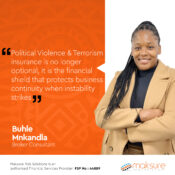
Buhle Mnkandla is a Broker Consultant at Maksure Risk Solutions. With a deep focus on building strategic intermediary networks, Buhle bridges the gap between independent insurance brokers, financial advisors, and specialised corporate risk structures. Leveraging Maksure's Afro-Global footprint and Lloyd's of London market access, she works closely with technical teams to deliver innovative, tailored risk transfer and business continuity solutions that protect enterprise assets and strengthen balance sheet resilience across complex operational landscapes.
Recent Posts

Unlocking Africa’s Industrial Future: The Nyanza Light Metals Project.
Beyond the Premium: Why Risk Engineering Drives a Lower Total Cost of Risk

Beyond the Valuation: Why Insurance Due Diligence is the True Guardian of M&A Success
The Strategic Importance of Political Violence & Terrorism Insurance